In the previous article, we discussed how to maintain our inner peace during moments of emotional change and how to remain flexible without rigidly adhering to a rhythm.
However, given the potential for this topic to easily veer into avoidance, I believe we need to reflect on the difference between adapting and avoiding.
Just the other day, I had an experience like this: I convinced myself before going to bed that night that I would write in the morning. But when I woke up, I don't know if I had clenched my teeth during the night or had a nightmare, but I felt constricted and my mind was scattered. 'I feel different today, I'll be kind to myself, I won't force the rhythm,' I said.
But in the afternoon, I realized that I wasn't actually avoiding writing because I was tired. I avoided writing because what I was going to write was bothering me. There was something on the page I needed to face, and I had turned my back on it by calling it 'flexibility'.
As Sartre said, 'bad faith' (mauvaise foi) sometimes takes on the most elegant guises. When we lie to ourselves, we never do it with a crude or ridiculous lie. Instead, we do it with reasons that seem very polite, very compassionate, very 'conscious' in order to fit the mold.
In this article, we will dissect the anatomy of those polite lies and do our best not to do harm while thinking we are doing ourselves good.p>
The Philosophical and Scientific Background of the Topic
Philosophical Perspective
Sartre: Bad Faith (Mauvaise Foi) and Self-Deception
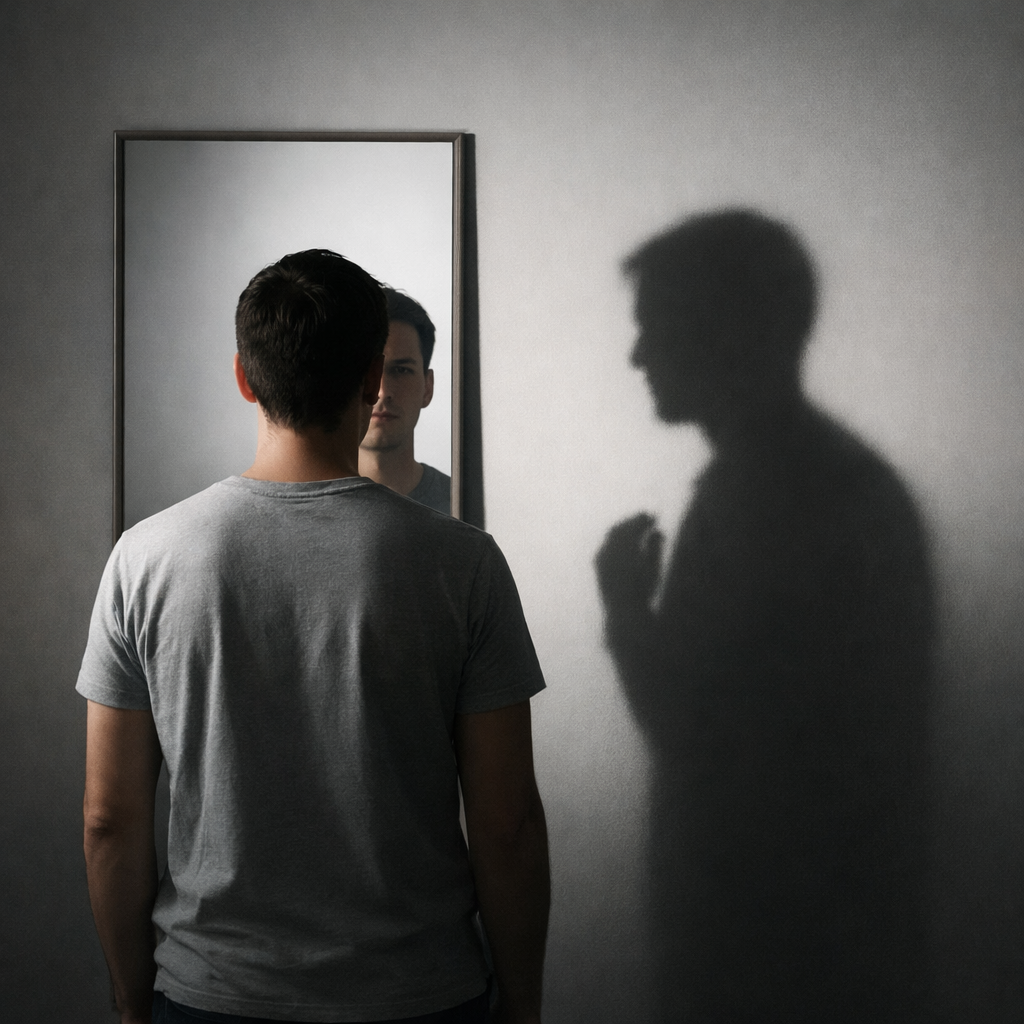
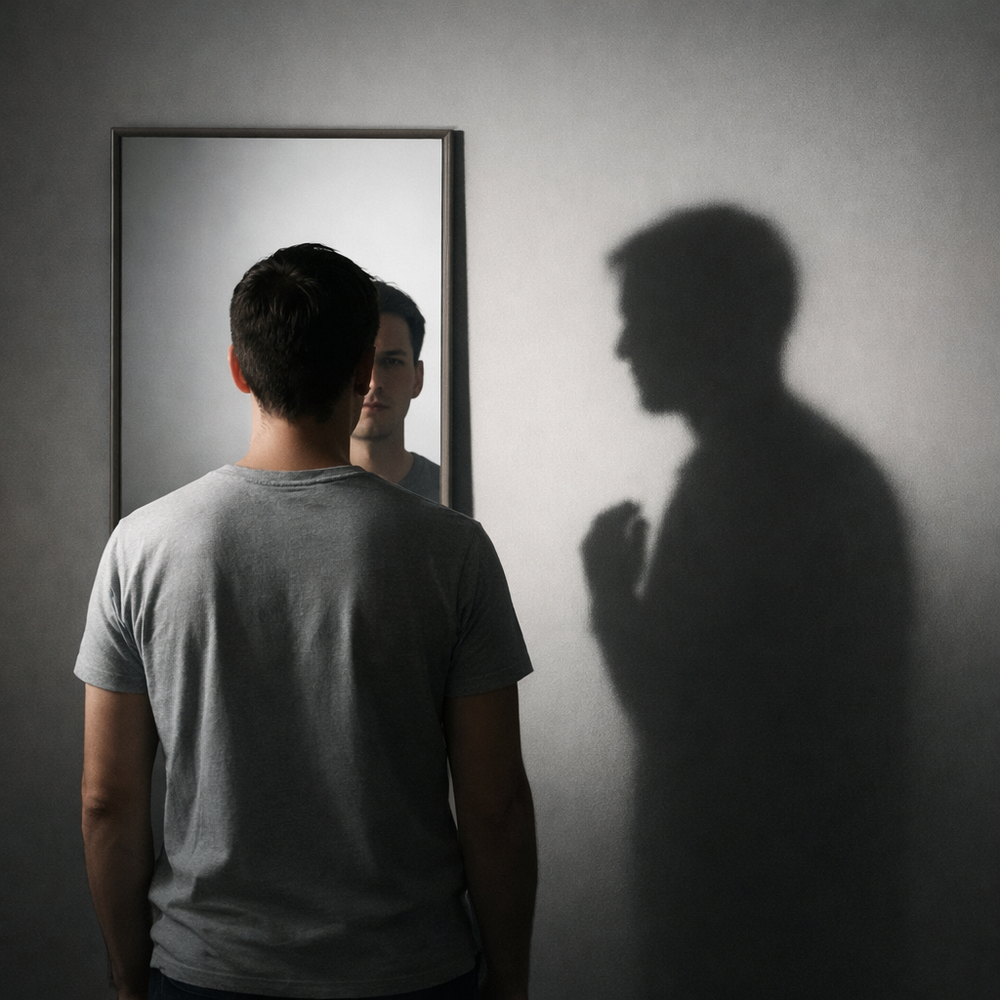
Sartre reminds us of a very uncomfortable but equally liberating truth: The responsibility for our own lives always rests on our shoulders. And this responsibility is directly linked to our choices. Because, according to Sartre, we construct who we are with every choice we make. The painful part is this: we often use the most elegant, most compassionate masks to escape this burden.
This is precisely where Sartre's "bad faith" (mauvaise foi) comes into play. (1*)
For example, when we say to ourselves, "Today I will treat myself well, I will rest," this can be a truly self-compassionate choice.
But sometimes there is a deeper truth behind this sentence: In reality, there is a responsibility we don't want to face, an uncomfortable feeling, or a decision we don't want to consciously make. In this case, the mask of compassion becomes a polite cover for escaping the weight of our freedom.
Let's recall Sartre's famous waiter example: He is so absorbed in his role that he doesn't just act like a waiter, he almost becomes a waiter. Forgetting his own freedom provides him with temporary comfort; because freedom also means responsibility and anxiety.
Similarly, in our modern lives, we can deceive ourselves with appearances of being "flexible," "compassionate," or "conscious." In reality, however, these polite lies keep us from growing and from facing the consequences of our choices.
Therefore, the fundamental question, as Sartre reminds us, is this: Is the choice I am making right now truly a choice made in awareness of my freedom, or is it a moment when I am fleeing the weight of my freedom? Being able to ask ourselves this question is both uncomfortable and liberating.
Kierkegaard: Anxiety and Escape
Kierkegaard calls that subtle dizziness experienced in moments of feeling human freedom anxiety. Because freedom means not only unlimited possibilities, but also a renunciation and a loss behind every choice. To choose one thing is to silently bury all other options.
This is why flexibility sometimes takes on the very appealing guise of escape. "I go with the flow, I can change at any moment" sounds wise; but sometimes it is actually a poetic way of choosing not to choose anything.
Kierkegaard's warning is precisely here: The moment we say "anything is possible," we unknowingly approach saying "I am nothing." (2*)
For me, this brings about the following awareness:
Sometimes flexibility is truly listening to the rhythm of life. But sometimes it's just a fancy name for dithering in uncertainty. We may be telling ourselves stories of fluidity to postpone the anxiety that comes with making a choice, so it's good to be careful.
Spinoza: Our Passive Emotions (Affectus Passiva)
Spinoza reminds us: When we don't know the cause of our emotions, we become their prisoners. Is it enough to say, "I feel different today" when we wake up in the morning? Why do we really feel different? When we don't ask this question, the emotion carries us away, and we become passive without realizing it.nbsp;
According to Spinoza, acting on our emotions is sometimes our most passive state. Because in that moment, we are not making our own choice; we are riding the wave of emotion. True freedom is not going unconsciously in the direction an emotion pushes us; it is seeing that emotion, naming it, and establishing a conscious relationship with it. (3*)
Perhaps we should ask ourselves this question: "Do I know the source of what I am feeling right now?" If our answer is no, then most of the steps we take may actually be passive. Awareness and naming are the first gate that prevents emotions from controlling us.
Scientific Perspective
At this point, it is important to shift from a philosophical framework to a scientific one. Because seeing that these subtle games we play with our emotions are not just abstract ideas, but are based on concrete psychological and neurobiological foundations, provides powerful support for being honest with ourselves.
Psychology: Avoidance Behavior
In psychology, avoidance behavior is defined as the effort to stay away from uncomfortable thoughts or feelings. The concept of experiential avoidance is particularly critical here: We avoid actions that trigger feelings such as unease, anxiety or guilt that arise within us. (5*)
In the short term, this approach gives us a sense of relief. Not writing, not calling, not talking... All provide momentary relief. However, in the long term, this behavior exacerbates the problem. Because postponed confrontations accumulate in the shadows of our minds and reappear as more intense anxiety or guilt.p>
Interestingly, phrases that sound wise, such as "being flexible," "giving myself space," or "going with the flow," are sometimes just sophisticated versions of experiential avoidance.
Therefore, realizing whether our well-intentioned compassion is whether there is a hidden escape is the first step toward true self-compassion.
Neuroscience: The Amygdala and the Avoidance Response
The amygdala, one of our body's fastest alarm systems, detects threats to our survival and prompts us to act. Most of the time, these threats are physical; they trigger a reflexive avoidance that alters our path. However, in modern life, threats to our brain are not always tangible.
Sometimes just an email, a paper that needs writing, or a postponed conversation can trigger the amygdala.
Because the brain often perceives emotional distress as a real danger. That's why, when we change our rhythm or say "I won't do it today," we may actually be heeding our brain's "stay away from danger" signal.
Neuroscience research by LeDoux (2015) and Barrett (2017) reminds us that the brain is often not very good at distinguishing between physical and emotional threats. Therefore, slowing down the rhythm may sometimes be a disguise for a hidden avoidance reflex from the amygdala, rather than conscious self-compassion. (6*, 7*)
Self-Deception Studies
The human mind is often much more cunning than we think. It is certainly possible to deceive others, but we show our true mastery in deceiving ourselves.
Research shows that people deceive themselves much more easily than they deceive others. This is because, in our inner world, bending the truth to be right and maintain our peace of mind is often more appealing than we think.
At this point, two important psychological concepts come into play:
Motivated reasoning:
What we see, hear, and remember is often shaped by our desires. We are not impartial when we come into contact with reality; we unconsciously choose what we want to see.
Self-serving bias (Self-serving bias):
Our minds bend the truth, and sometimes completely rewrite it, to make us feel good about ourselves and protect our self-image. For this reason, we often take credit for our successes and blame external factors for our mistakes.p>
These processes are the cornerstones of self-deception. The stories we tell ourselves are often not conscious lies; rather, they are the versions we want to believe. This is why self-deception is difficult to recognize. Because even if they are false, they appear real to us. (8*, 9*)
Real Problem and Solution Suggestions
The Real Problem
How Do We Distinguish Between Adaptation and Escape?
The problem is that, from the outside, they both look almost the same.
Behind accommodation lies a mindset such as "I'm too tired today, I'll leave the writing until tomorrow, I'll give myself some space." During avoidance, similar thoughts cross our minds.
The sentence is the same. The tone is the same. But one is genuine self-compassion, the other is a gentle self-deception. That's where the fine line begins.
So how can we tell the difference?
The Layer of Intention
When making this decision, are we moving away from something, or are we moving toward something?
Pattern Control
Is this a one-time occurrence or a recurring escape mechanism? Do we use the same excuse every time we struggle?
Next Emotion
After making our decision, do we feel relieved, or do we feel a sense of guilt or unease?
Emotional Burden
Does this decision lessen the weight we feel, or does it merely postpone it?
The interesting thing is that avoidance never tells us, "You're running away." Instead, it sweetly whispers in our ear, "You're taking good care of yourself."
Solution Suggestions
First Steps to Being Honest with Ourselves
Sometimes, we need to take simple but effective small steps to face ourselves. I made a list of a few points for myself, and I'll share it with you...
Asking "Why?" Three Times
For example, when I say "I don't want to write today" in the morning, I can immediately ask myself:
Why?
Because I'm tired.
Okay, why am I tired?
Because this writing is making me nervous.
Well, why is it stressing me out?
Because I have to face myself while writing.
Usually, the third answer reveals the heart of the matter. This is where the "real reason" emerges.
Asking "What If I Hadn't Avoided It?"
If I had done this, what would have been the worst that could have happened? Was that "worst" truly unbearable, or was it just unpleasant and uncomfortable? Avoidance is often an attempt to protect oneself from an imagined catastrophe.p>
Pattern Recognition with the Escape Log Book
For a week, I note down whenever I act "flexibly." Then I look back: Am I flexible about the same things?
For example, if I'm consistently lax about writing but never lax about social plans, that gives me an important clue.p>
The "Both at Once" Experiment
I can try to maintain both flexibility and responsibility. For example: "I can't write much today, but I'll write for 10 minutes."
If I don't even want to do that, it probably means I'm running away.
The "Future Me" Test
I ask what my future self would say about today's decision: "I'm glad I rested," or "I wish I had done it"? The feeling of regret usually carries traces of avoidance.
Naming the Feeling
Saying "I feel different" is not clear enough. What am I really feeling? Fear, anxiety, anger, or loss? As Spinoza said, naming the emotion is the first step toward getting rid of it.
A Delicate Balance
But there's a very important point here:
This article is not about 'always pushing yourself'.
Sometimes you really need to rest, withdraw, and slow down. Self-compassion is real and valuable.
The problem is that avoidance can also present itself as self-compassion.
So I find it helpful to understand this:
Questioning ourselves is not the same as punishing ourselves.
Being honest does not mean being cruel.
Being aware does not mean feeling guilty.
I think what will mature us is sometimes being able to say 'I can't do it today' and being able to recognize whether this is an escape or not.
As Jung said: 'Human development is never complete; humans are constantly developing.' (Man wird nicht, man ist immer im Werden.) (4*)
We are also constantly learning. Why don't we learn whether we were really tired this time, or whether we just reverted to our old familiar pattern?
Conclusion and Message to the Reader
As I come to the end of this article, I realize that being flexible often does us good. But not every stretch means inner growth. Some stretching is actually just bending; a maneuver we do to protect ourselves, to avoid breaking.
And that's understandable. Because sometimes we really are on the verge of breaking. But sometimes we just feel uncomfortable and confuse that discomfort with breaking.
It is precisely at this point that we need to be both compassionate and honest with ourselves. Perhaps the deepest question we should ask ourselves is: Am I protecting myself within this flexibility, or am I running away from myself?
And then, an even more important question arises: If we realize that we are indeed running away, lying to ourselves, what should we do? Should we forgive ourselves, or force ourselves to change?
In the next article, we will look at the steps that can be taken after this realization; how honesty and compassion towards ourselves can coexist.
Until then, approach yourself with both love and honesty.
References and Inspirational Texts
- Sartre, J.P. - Being and Nothingness (The Bad Faith section)
- Kierkegaard, S. - The Concept of Anxiety
- Spinoza, B. - Ethics (The Geometry of Emotions)
- Jung, C.G. - The Undiscovered Self
- Hayes, S.C., et al. (1996) - Experiential avoidance and behavioral disorders
- LeDoux, J. (2015) - Anxious: Using the Brain to Understand and Treat Fear
- Barrett, L.F. (2017) - How Emotions Are Made
- Trivers, R. (2011) - The Folly of Fools: The Logic of Deceit and Self-Deception
- von Hippel, W. & Trivers, R. (2011) - The evolution and psychology of self-deception