There are certain thoughts that have been on my mind for a long time—thoughts I’ve adopted as my philosophy of life. My readings of Mevlana, my explorations of the subconscious, and my spiritual quests have all led me to similar conclusions. Someone once said, “My brother, you are nothing but ideas and thoughts. The rest is merely bone and flesh—which even animals possess.” If you think of roses, you become a rose garden; if you think of thorns, you become a thornbush. Another said, “Whatever you repeat, you become.” Yet another said, “Whatever you seek, seek it within yourself—it is not in Jerusalem, Mecca, or the Hajj…”
In short, the conclusion I’ve drawn from distilling this information is right there in the title of this post.
A few years ago, I got this tattooed on my arm so I wouldn’t forget it. 😅
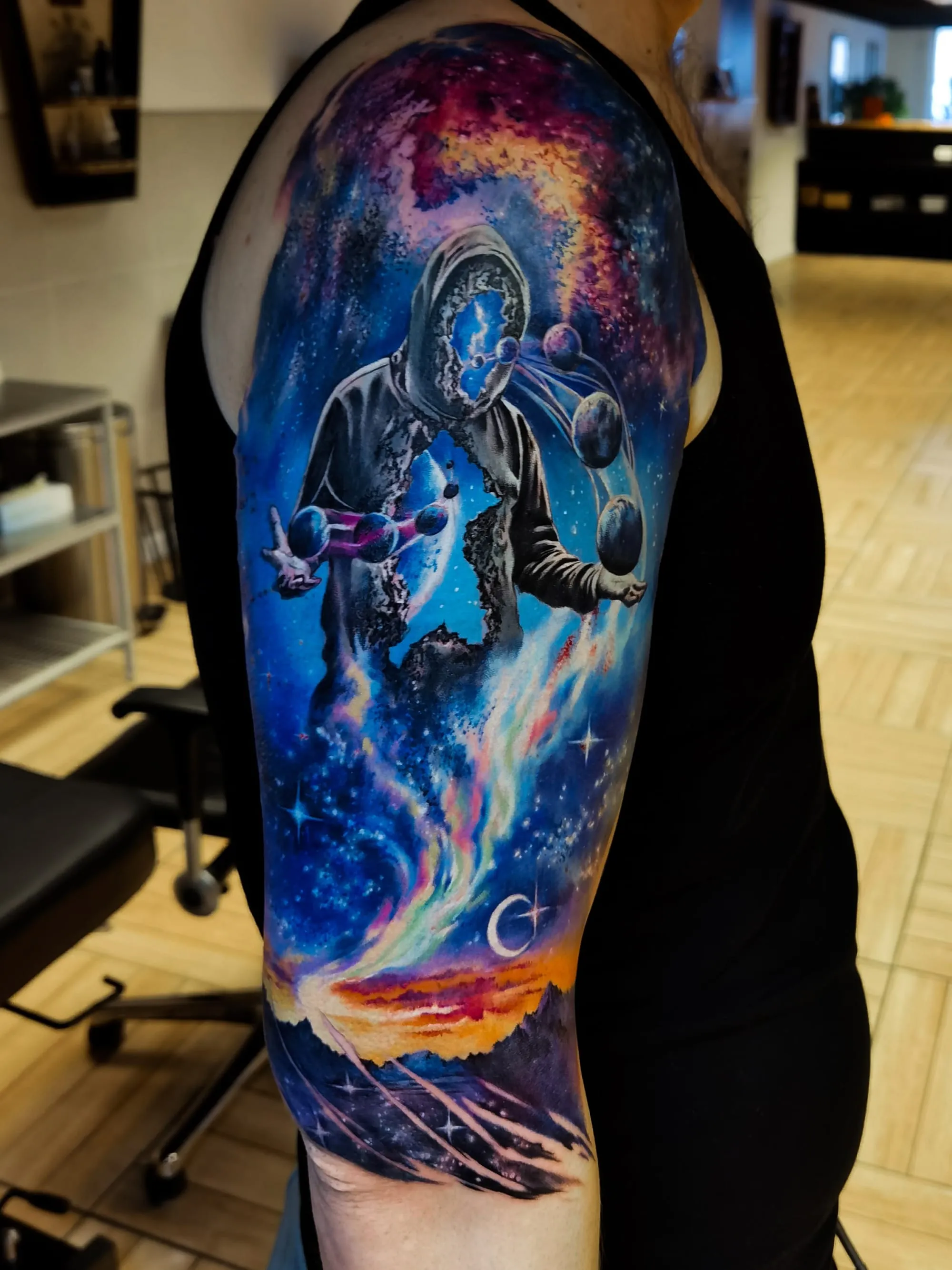
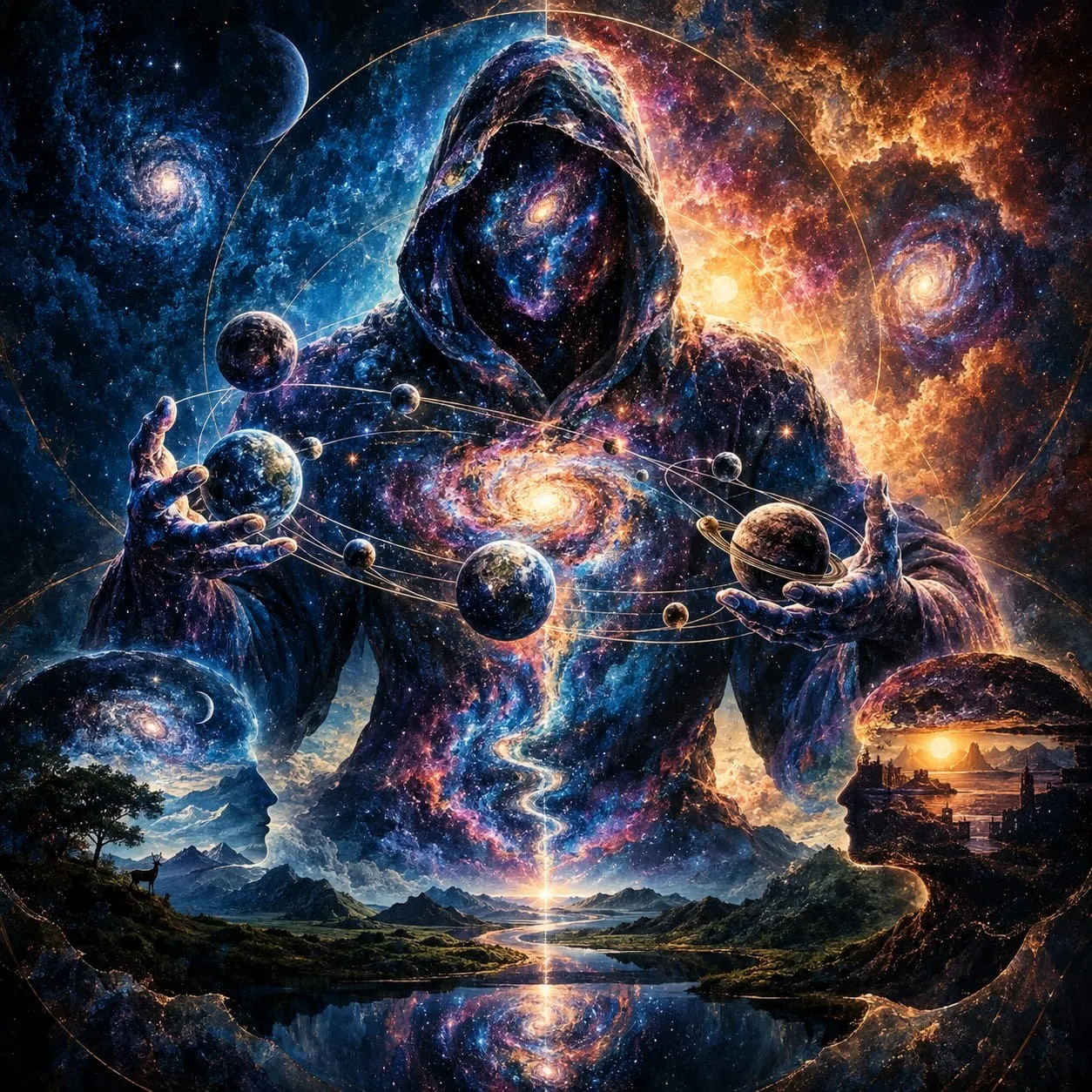
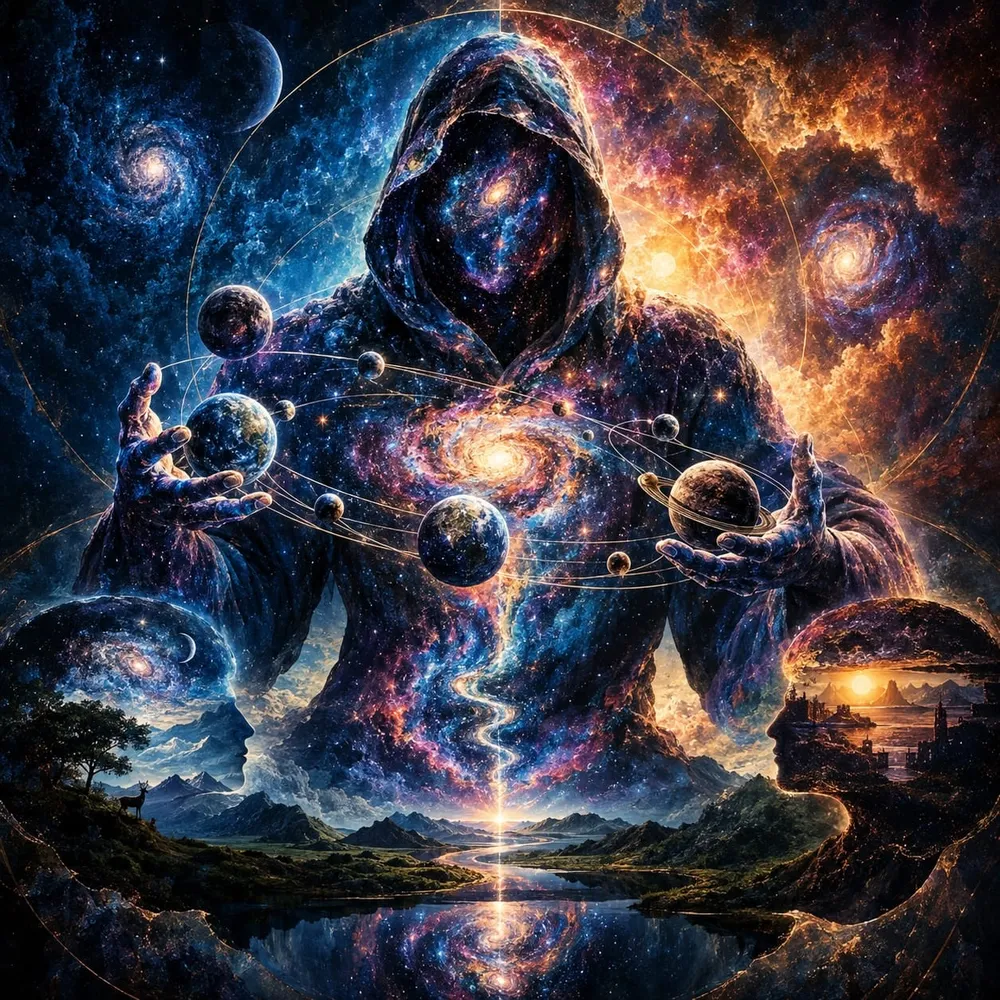
There’s a hooded figure, spinning the planets with its hands. But if you look closely, you’ll notice: the figure itself is made of that universe. It has no face, no body—it’s all space inside. So it’s both spinning the universe and the universe itself.
To those who asked me what it meant, I always said this: the universe creates humanity, and humanity creates the universe.
Back then, I think I liked it simply because it sounded like a nice phrase; I had it made without the thoughts I mentioned at the beginning in mind. But years have passed, and I’ve realized that for me, this isn’t just a saying—it’s a way of life. In short, I’d say this is the sentence that describes how I view life.
In this post, I’ll try to explain it.
But to explain it, I first need to touch on a few points—get ready for a journey.
Let me start by saying this: I didn’t choose myself.
I didn’t choose the country I was born in. I didn’t choose my family, the first language I heard, the truths I was taught, or the phrases whispered in my ear as a child. I didn’t choose which neighborhood I’d grow up in, which school I’d attend, or who my first friends would be.
All of these were given to me. And thankfully they were—I have no issue with how things turned out; in fact, I’m grateful—but ultimately, these are the things that were given to me, and what I’ve been able to take from them. And these gifts have brought me to a certain point.
So the universe truly created me. It didn’t just create my atoms—it also shaped my fears, my habits, and even what I find beautiful or ugly. Perhaps even my favorite meal today was something someone fed me when I was very young; I loved it then, and it’s always stayed with me—that’s why I love it so much.
I think accepting this is a necessity. Because if we don’t accept it, we imagine ourselves as people who came into existence from nothing, who came up with every idea on our own, and made every choice by ourselves. But that’s not who we are. None of us are.
But there’s another side to this, too. And that’s where it gets really interesting. I’ll explain this using myself as an example, but I think these things apply to everyone.
I, too, am creating a universe.
With what I know, what I believe, what I’ve experienced, and my habits, I’m building a universe of my own. The boundaries of that universe are drawn by my knowledge, its color is given by my beliefs, and its workings are determined by my experiences.
And here’s the strangest part: that universe seems “complete” to me. I don’t feel like I’m living in a place that’s lacking anything. It feels as if I’m looking at reality itself.
Yet I’m not really looking at reality. I’m only looking at what I’ve created myself.
After pondering this idea on my own for years, I realized I wasn’t the only one thinking this way.
Biologist Jakob von Uexküll had a concept called “Umwelt.” According to him, every living being lives in its own perceptual world. The example he gave really stuck with me: for a tick, the universe consists of three things. Temperature, the smell of sweat, and the sense of touch. In a tick’s universe, there is no color, no sound, and no such thing as the sky. (1*)
But the tick doesn’t think it lives in an incomplete world. For it, the universe is whole.
What Uexküll demonstrates is this: a tick, a dog, and a human standing in the same forest each live in three separate universes. There is only one forest, but there are three universes.
When I read this, I said, “That’s it.” Because the same thing applies among humans; we just don’t see it because the difference is more subtle.
I found one more thing, this time from our own soil.
Centuries ago, when Ibn Arabi was describing the relationship between humans and the universe, he said something like this: “Man is a microcosm; the universe is a macrocosm.” (2*)
In other words, they are not separate things. One is within the other, and the other is within it.
When I first read this, I looked at my arm. The figure in my tattoo was describing exactly this, and when I got it done, I didn’t even know such a concept existed.
So it seems people have long been aware of this cycle; they’ve just expressed it in their own words.
Now I’m coming to a somewhat painful point.
Since each of us creates our own universe, then when two people stand side by side, it actually means two separate universes are standing side by side.
Here’s how I see it: each of us is looking through a cone. The cone defines the field of view we see. And if the fields of view of two cones don’t overlap at all, then those two people, sitting in the same room and looking at the same event, are seeing two completely different things.
Neither of them is lying. Neither of them is stupid. Both are consistent and right within their own universes.
The reason they can’t understand each other isn’t bad faith. It’s the lack of an overlapping area.
Ever since I realized this, my perspective on arguments has changed. Now, when I think, “How can this person not see this?”, I first take another look at my own cone.
But what I really want to say starts here, and I think this is the most important part of this post.
The overlap isn’t fixed.
It’s something that can be expanded. And expanding it is a choice.
How does it expand? By asking the other side what they see. By sharing the same experience, working together, sitting at the same table. By reading the same book, laughing at the same thing. By trying—even just once—to see things from their perspective.
As the intersection grows, the two worlds draw closer to each other. Of course, they don’t completely overlap—that’s neither possible nor necessary. But a shared space emerges. And in that space, we can truly communicate.
I don’t think what we call “understanding” means crossing over to the other side. It means creating a third space where both of us can stand.
Then this question becomes legitimate: what kind of world are we creating?
Because we’re creating that universe anyway—whether we’re aware of it or not. And that comes with a responsibility.
There are a few questions I ask myself on this subject:
Who do I let into the universe I’m creating? Only those who are like me, or even those who make me uncomfortable?
Who selects the information that enters my universe? Me, or an algorithm that decides what to show me?
Am I trying to expand the intersection, or am I defending the boundaries of my own universe?
And perhaps most importantly: Am I aware that I’m creating a universe? Because if I’m not aware, it means someone else—or the process of creation itself—is building it in my place.
While thinking about these things, I realized something else.
If the universe is creating me and I am creating the universe, this cycle doesn’t have to be a one-way descent into darkness. The same cycle can also turn toward the good.
Whatever kind of universe I create, that universe shapes me accordingly. Then, with that new form, I can create an even better universe. And so it goes.
So it’s not about some grand plan of salvation. It’s about widening the angle of your own cone a little. Connecting with one more person. Saying “I wonder” about one more thing.
It seems small. But because it’s a cycle, it doesn’t stay small.
Once again, I’d like to share these practices I’ve developed for myself with you:
When talking to someone you didn’t see eye to eye with today, ask: “I want to understand your perspective—exactly where are you coming from on this issue?” Not to refute them, but out of genuine curiosity.
Write down the three things that make up your own universe: a belief, a habit, and a fear. Then ask yourself, “Did I choose these?”
Do something together with someone whose ideas never intersect with yours. You don’t even have to talk—just experiencing the same thing is enough.
This week, deliberately introduce something foreign into your universe—a book, a piece of music, a perspective.
When you disagree with someone, try to figure out what information exists in their universe but not in yours.
Ask yourself every now and then: Is the world I’ve created today a little broader than yesterday’s?
To be honest, I hadn’t thought this far ahead when I got the tattoo. I got it because I thought it was a beautiful image, a beautiful idea. It turns out there was so much more to it that I didn’t know about. Or maybe my mind knew but hadn’t told me yet—something like that.
But I do know that over the years, that phrase has grown along with me. Now, when I look at it, I don’t just see a figure. I see a reminder: the world I see may have been given to me, but the world I build is up to me.
Do I always build it right? No. Most of the time, I get stuck in my own mind; most of the time, I choose to defend myself rather than connect.
But at least I know what I’m doing now. And I think that alone is a start.
I’d like to ask you, too: What kind of universe have you created? And who else is there in that universe besides you?
See you in the next post. Until then, stay in love.
(1*) Jakob von Uexküll, A Stroll Through the Worlds of Animals and Humans (1934)
(2*) Ibn Arabi, The Meccan Revelations (13th century)