
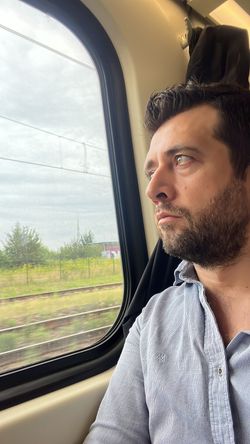

The other day, my wife went to rehearsal with her band, and I was home alone. I didn’t have any urgent tasks to do or anywhere I needed to go. I lay down on the couch. I thought, “I’ll just stop for a bit.” Those who know me know I like to stop. In fact, even when asked, “What are you doing?” I sometimes answer, “I’m stopping.” But I realized that those “I’m just stopping” moments were just talk.
To be honest, I didn’t count, but I could barely manage to stop for about forty seconds or so.
At first, my hand reached for my phone on its own. I wasn’t even aware of it—before I knew it, I was scrolling through Reels on the screen. Then I caught myself and put the phone down. I paused for a little while. This time, the thought, “I might as well practice the guitar a bit,” crossed my mind. But I realized it right away. I gave that up too. I’m determined, after all—I’m just going to sit here. Then I thought, “Maybe I should start writing this article.”
Finally, I caught myself asking: Why can’t I just sit here and do nothing?
Then I realized this isn’t just something I do when I’m alone because my wife went to rehearsal—it’s not actually something specific to that situation.
We pull out our phones while waiting in line. We stare at our screens in the elevator. We put on our headphones while walking. We even take our phones with us to the bathroom—let’s admit it. We fill every spare moment with something, and we don’t even realize it.
Then one day, if we were actually going to do absolutely nothing, we’d feel restless. It’s as if an alarm is going off somewhere inside us: “Get up, do something.”
At least that’s how it is for me. But I didn’t stop there—I immediately wondered where this alarm was coming from.
Actually, I can’t say we’ve completely stopped resting. We do rest. But there’s a trap here, and I think this is what we really need to pay attention to.
We’ve turned even rest into a servant of productivity.
We’ve all said things like: “I’m recharging a bit.” “I’ll clear my head and come back.” “My productivity drops without a break.” “I need a vacation, or I’ll explode.”
Notice that there’s a justification in each one. We don’t defend rest for its own sake. We consider it legitimate only if it means we’ll work better afterward, or be more productive.
In other words, even a break has become part of the workday.
I think something Byung-Chul Han says in his book *The Burnout Society* fits this perfectly. According to him, there’s no longer a boss exploiting us—we’ve taken on that role ourselves. We are both our own workers and our own bosses. (1*)
And that’s why work never ends. Because if the boss you’re trying to escape is you, where can you run?
So is doing nothing really “nothing”?
The philosopher Josef Pieper wrote very clearly on this subject in 1948. According to him, what we call “free time” does not mean resting nor is it simply time left over from work. It is an entirely different state. (2*)
Pieper calls this the state of receptivity. That is, the ability to simply perceive, without trying to produce, transform, or process the world.
And according to him, culture, art, and philosophy have all emerged from this—not from brief breaks in the midst of work. From people who can truly come to a standstill.
Bertrand Russell also approaches this from a similar perspective in his book *In Praise of Idleness*. He argues that the idea that work is a virtue in and of itself is actually a doctrine that serves the interests of certain people. (3*)
The conclusion I draw from all this is this: even when we say “doing nothing,” we’re using a derogatory word. “Empty.” As if there were nothing there at all.
The scientific evidence also shows that doing nothing is actually “beneficial.” There are studies indicating that when the mind wanders freely, problem-solving capacity increases. We’ve all experienced it: you rack your brain for hours over a problem and can’t solve it, then suddenly the answer pops into your head while you’re taking a shower, on the toilet, or walking down the street.
But since our topic is “stopping,” let’s pause right here in the article.
Even as I’m writing this, I’m trying to argue that doing nothing is “actually beneficial.” Did you notice?
That’s the crux of the matter. If we feel compelled to prove the benefits of something in order to defend it, it means we’ve already fallen into that trap.
Even if doing nothing has no benefits, it’s still our right. And I think that’s the real point that needs to be made.
So why is this so hard?
I don’t think the culture of productivity alone explains this situation. There’s something else.
When we do nothing, we’re left alone with ourselves. And that encounter isn’t always easy.
Sometimes we use busyness as an escape. After all, as long as there’s something to do, we don’t have to think. The conversation we’ve put off, the feeling we’ve suppressed, the question we’re afraid to ask… They’re all waiting behind the next task.
Now I’m slowly beginning to understand why I could only last such a short time on the couch the other day. Maybe the reason wasn’t an alarm inside me. Maybe I was looking for something to keep me busy so I could escape from myself— because what I might hear in the silence frightened me.
Actually, there’s a very beautiful word in our language: keyif.
You can’t translate it exactly into English. It’s not “pleasure,” not “enjoyment,” and certainly not “relaxation.” “Keyif” isn’t a goal, it doesn’t produce an outcome, and it isn’t preparation for anything. It’s simply that state of being.
The Italians have a similar expression: “dolce far niente”—the sweetness of doing nothing.
Both cultures have affirmed this with a single word. So, at one time, we knew this was a legitimate thing.
Perhaps we’ve lost that word, even though the word itself remains where it is.
By now you’ve come to know me—I take the insights distilled from my stream of consciousness and my readings and turn them into a practice, even if it’s just to help myself “pause,” and I’m sharing them with you; I’ll do the same again.
These are practices I’ve prepared for myself but don’t want to keep from you—maybe they’ll be useful to you:
Today, do nothing for fifteen minutes. No phone, no music, no book. Just sit. Notice the restlessness that arises within you during that time. What is it telling you?
Catch the thought that forms while you’re resting. Are you saying, “I’m recharging,” or are you just resting?
Don’t pull out your phone while waiting in line; take a look at what’s going on around you.
If you feel guilty when a day goes by without you producing anything, think about who or where that guilt was passed down to you from.
This week, do something just for the fun of it. Something that serves no purpose, that you won’t tell anyone about, and that in the end, only you will enjoy. Something just for yourself.
As I was writing this, I couldn’t help but notice something about my own life.
Even when I’m playing the guitar, I’m constantly chasing productivity. The moment I pick it up, I immediately think, “What skill am I going to improve today?” . Am I keeping perfectly in time with the metronome? Are my repeats accurate? Are there any mistakes in my timing? Am I making progress...
But sometimes, there’s also such a thing as just picking up the guitar and playing for the sake of it. Without worrying about progress, without measuring, without going anywhere.
While writing this post, I tried that a few times. I played a few things I knew, didn’t try to learn anything new, and when I made a mistake, I didn’t go back to correct it. I just played.
Strangely enough, I hadn’t enjoyed holding the guitar this much in a long time.
You can’t escape it either—here’s a question for you: When was the last time you did absolutely nothing? And were you really doing nothing at that moment, or were you preparing for the next thing you were going to do?
See you in the next post. Until then, stay well.
(1*) Byung-Chul Han, The Burnout Society (2010)
(2*) Josef Pieper, Leisure: The Foundation of Culture (1948)
(3*) Bertrand Russell, In Praise of Idleness (1932)