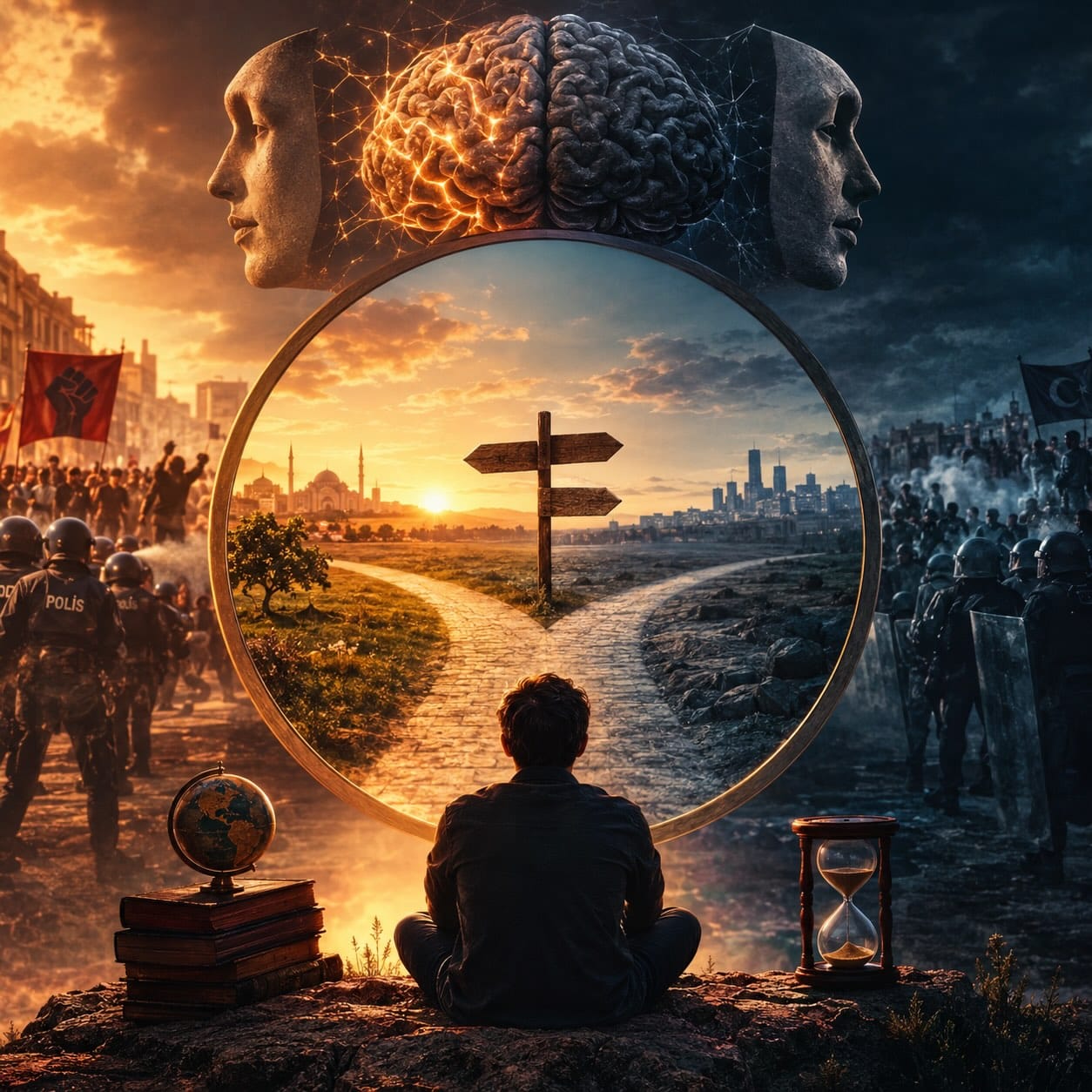

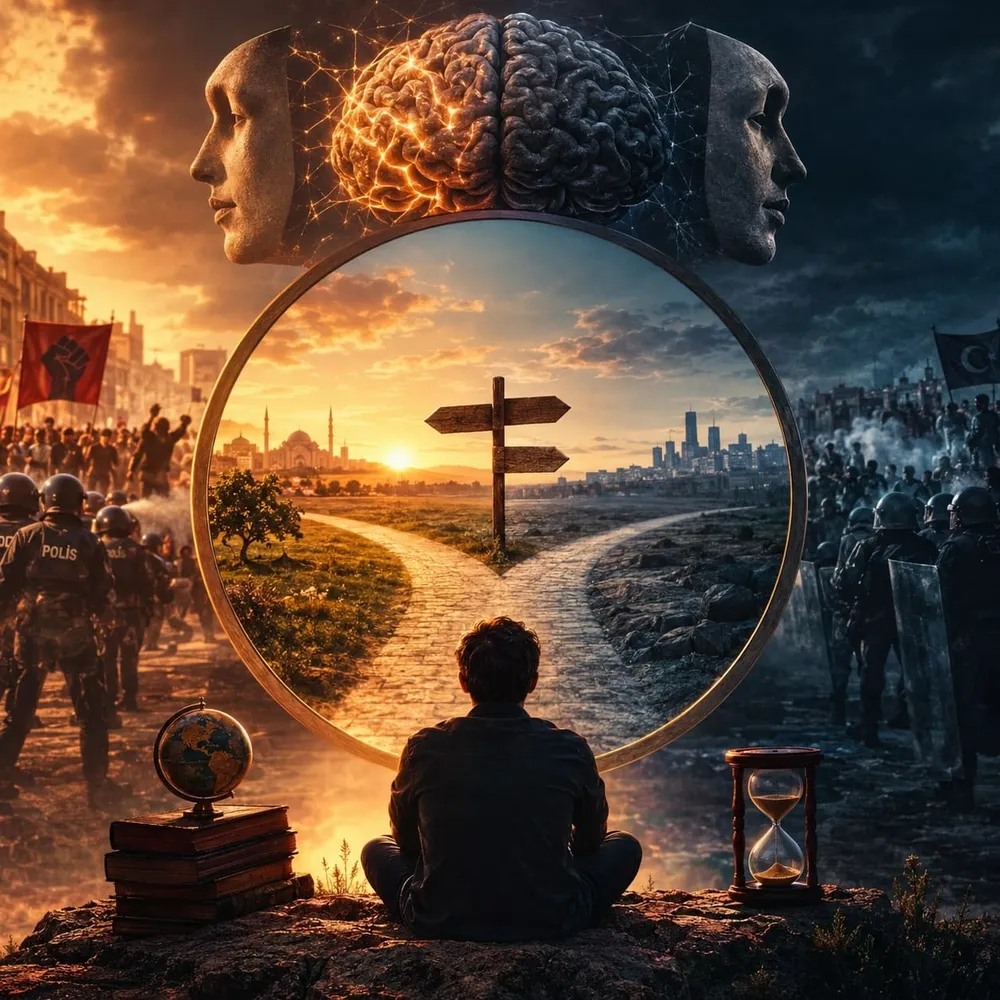
The other day, while browsing Twitter, I came across a news story. In a certain country, a group of people had taken to the streets to protest the government, and the police had cracked down hard on the protesters. As I read the news, I felt frustrated, and I caught myself asking, “How can such injustice happen? Are people no longer able to defend their rights?”
Then, on the same day—since the algorithm knows I click on these kinds of news stories—it immediately tagged me, thank goodness. A news story about almost exactly the same situation in another country popped up. I clicked on it, wondering what it was about. Similarly, people were in the streets, crowds were protesting, and the police were intervening in a similar way. I looked at the country where it was happening—I don’t want to name it here and offend anyone. I hesitated for a moment, thinking, “Oh well, things are already chaotic there,” and moved on.
Then I stopped and felt a bit ashamed of myself. What happened, really? What changed? I even scolded myself, thinking, “Aren’t the people in the first country human too, just like those in the other country?”
In the end, the situation is the same; the only thing that changed was who did it. That’s what prompted me to write this post.
Before I dive deeper into this post, I need to say something briefly.
We’re all living in a feed that confirms our own opinions now. Whatever we like, we get more of it right in front of us. Whichever party we support, we see its news; whichever view we defend or whichever team we root for, we see comments that reinforce it.
We know this narrows our access to information; I’ve written about this before. But recently, I’ve had a different realization: this narrowing doesn’t just affect the information we access—it also affects our moral judgment.
In other words, the issue isn’t just that “we’re receiving misinformation.” The issue is that the way we decide what is good and what is bad is beginning to break down as we try to keep pace with the changing times.
I’d like to digress here, because this is something I’ve been thinking about a lot.
The brain’s operating principle is more or less well-understood. The pathways we use repeatedly strengthen, while those we don’t use weaken and, over time, are pruned—or even disappear entirely. This is called synaptic pruning. In childhood, for example, there are critical periods; once those windows close, it’s truly impossible to make up for the loss of certain connections.
Now let’s apply this to our world of thought.
If we only hear views that mirror our own, it means we’re never using the “muscles” that process counterarguments. I have no evidence that this physically shrinks our brains, so I won’t make that claim. But one thing we do know is that unused abilities atrophy over time.
And being able to understand the other side is also a skill.
Nietzsche has a well-known saying: “If you gaze long into the abyss, the abyss also gazes into you.” I think this quote still holds true today. If we look in a single direction for a long time, that direction eventually shapes our perspective as well.
So how exactly does this narrowing of perspective distort our moral judgments?
One of the distortions I’ve observed is that we begin to view a person or group as either entirely good or entirely bad. If If we’re Galatasaray fans, Fenerbahçe is terrible, and the same goes for the reverse. A perspective has begun to form in people where, no matter who we are, the other side is always the bad guy, as if we could never have any bad qualities—as if evil is always associated with the other side. Even though one might ask, “What’s the big deal?” the issue runs deeper; while this situation may seem to only harm the opposing side, it actually harms us first—and we don’t even realize it.
Psychologist Edward Thorndike noticed something interesting in 1920. He asked officers to evaluate their soldiers. When he looked at the results, he saw that when an officer liked a single trait of a soldier (such as his posture or appearance), he also gave high marks for that soldier’s intelligence, leadership, and loyalty. A single positive trait spills over into the entire evaluation. He called this the “halo effect.” (1*)
We see this everywhere today.
If a politician we like does something wrong, we say, “He must know what he’s doing.” If someone we dislike does something right, we say, “He’s definitely up to something.” The same behavior takes on a different meaning depending on who does it.
In other words, we’re evaluating the label, not the person. And once that label sticks, what that person actually does doesn’t really matter anymore.
The second issue is even more interesting. We don’t even need a real reason to create these labels.
Social psychologist Henri Tajfel conducted an experiment in the 1970s. He divided people into two groups completely at random. The criteria were meaningless—for example, guessing how many dots they saw in a grid. They had no shared history, and didn’t even know each other.
He then asked these people to assign scores to others. And he observed this: people began to favor members of their own group—whom they didn’t even know— while penalizing those in the other group. In fact, some even chose to widen the gap between their group and the other group, even at the cost of reducing their own group’s gains. (2*)
Even though there was no real stake involved. No history, no animosity.
This makes me think: We don’t need a reason for the “us versus them” distinction. A label is enough. And today, we have no trouble finding labels.
Now I’m getting to the point I really want to make.
There’s a thesis I really love in Yuval Noah Harari’s book *Sapiens*. According to him, what truly sets humans apart from other living beings is not their intelligence or their use of tools, but their ability to collectively believe in shared narratives. (3*)
Money, borders, flags, corporations, nations, laws… None of these exist in nature. If you held out a bill to a monkey, it wouldn’t even look at it. They’re all stories. But because millions of people believe in the same story at the same time, they’ve become functioning systems. And because they work, over time they come to feel like reality.
So far, so good. Without these stories, we wouldn’t be able to live in such large communities anyway. They’re tools.
Here’s where the problem begins: over time, these stories stop being merely tools that organize things and become the standards that define good and evil.
The same person is considered “one of us” because they were born on this side of a border, and “one of them” because they were born on the other side.
The same pain is either a tragedy or just another news story, depending on the color of the flag.
The same behavior is considered either courage or a crime, depending on who commits it.
Yet these were stories we made up. To make life easier. They were never meant to be the measure of morality.
When a child dies, the measure of that pain cannot be which flag the child was born under. But in practice, that’s exactly what happens. And the worst part is, we don’t even feel bad about it. Because the story tells us this is normal.
So what’s the way out? In my view, it’s not to say “well, everyone’s a little bit right” about everything. That’s just another kind of blindness.
There’s an idea that the philosopher Isaiah Berlin called “value pluralism.” According to him, even values that are truly good can conflict with one another. (4*)
Take freedom and equality, for example. Both are good. But if you pursue one to the extreme, you have to sacrifice the other. The same goes for justice and compassion. And security and privacy.
According to Berlin, this isn’t a shortcoming or a problem to be solved. It’s simply the nature of life. And maturity lies in accepting this conflict and making conscious choices between them.
In other words, the gray area isn’t a state of indecision. Reality itself is already gray. What’s black and white is our perspective on it.
As I was writing this, I realized something about my own life.
I’ve been living between two countries for ten years. And only now do I see that this has taught me something, even if unintentionally. I can interpret the same event from two different perspectives. When I look at a news story from Turkey, I see it one way; when I look at it from here, I see it another.
At first, this bothered me. It felt as if I didn’t belong anywhere. But then I realized that this isn’t a loss— it’s an opportunity. Because someone who can look through two windows can see something that someone looking through a single window cannot: the window itself.
And I think that’s the real issue. It’s not just about what we see, but also about being able to recognize where we’re looking from.
I’d like to share these practices—which I developed for myself—with you:
Take a news story you read today—one you’ve taken a side on—and ask yourself: How would I feel if the “other side” had done the same thing?
Recall a moment when you defended a mistake made by someone you love. What phrase did you use to defend them?
When you call someone “good” or “bad,” try to figure out which single trait you based that judgment on.
Write down the definition of the group you refer to as “us.” Did you choose this definition, or was it given to you?
Find two values that are both true but conflict with each other. Try to defend both, then decide which one to choose.
Deliberately follow someone who advocates a view you disagree with—not to refute it, but to understand how they think.
I’d also like to ask you: Think about the last person you called “bad.” Was it really what they did that made them “bad,” or was it which side they were on?
See you in the next post. Until then, stay well.
(1*) Edward L. Thorndike, “A Constant Error in Psychological Ratings” (1920)
(2*) Henri Tajfel, “Experiments in Intergroup Discrimination” (1970)
(3*) Yuval Noah Harari, From Animals to Gods: Sapiens (2011)
(4*) Isaiah Berlin, The Crooked Timber of Humanity (1990)