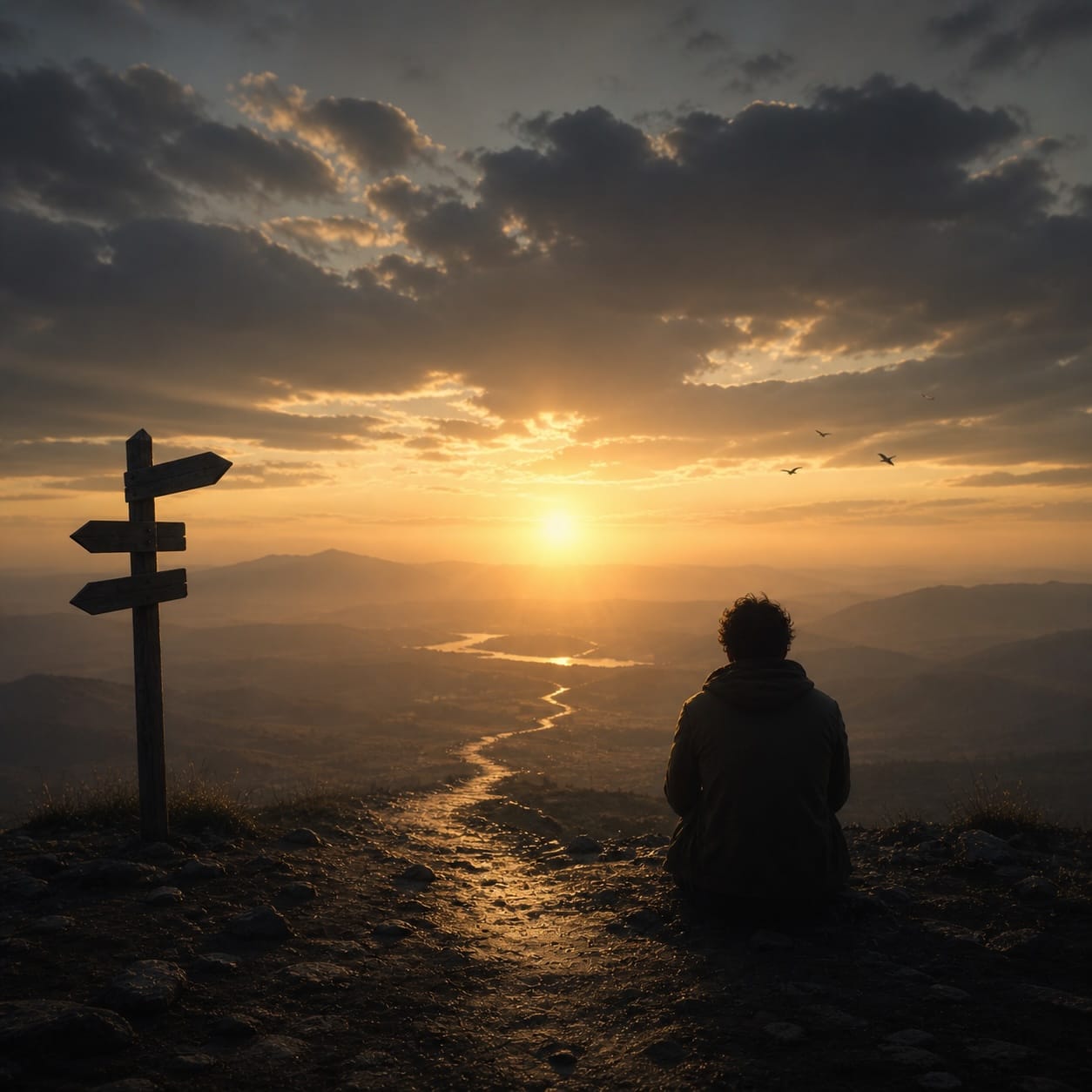


Let's say we are having a bad day. We are tired, we are depressed, something has gone wrong. We rebelled, we rebelled. We rebel against someone. We think that we should complain and let it cool us down. At that moment, someone we are complaining about and who we know is well-intentioned comes and says this:
"Be thankful, it could have been worse. You are never thankful."
And suddenly we feel even worse. We feel like, "What am I saying, what is he saying, I'm already bored, What should I be grateful for?" kind of thoughts start to form.
Have you ever wondered why this happens?
What is being said is not wrong, after all, there can always be a worse situation. Even from this point of view, what is said is right. we could even say. But it doesn't work for us. And not only does it not work for us, sometimes it can have the opposite effect. It's in us. And then guilt is added to that already existing feeling. "Why am I not thankful? Why don't I say thank you? If he goes through what I went through, will he be grateful?" We feel like something is missing in every way.
This is what gratitude looks like. It sounds simple, but once you get into it, things start to get complicated.
In this article I will explain why gratitude cannot be forced, what true gratitude feels like, and how the two the difference between the two from a philosophical and scientific point of view.
Philosophical and Scientific Background
Philosophical perspective:
Cicero says something striking about gratitude: "Gratitude is not only the greatest virtue, but all other virtues. is the mother of virtues." (1*)
But there is something we should pay attention to here. The gratitude Cicero is referring to is not a forced feeling. A stance that comes from within, born out of a true awareness.
The practice of Marcus Aurelius shows a much more concrete way forward. What the Stoics called negative visualization there's something. You imagine in your mind's eye that you have lost a moment of what you have. The people you love, your health, your daily the little details of your life. And then you see that they are still with you. (2*)
It's not necessarily gratitude, it's the brain standardizing what it experiences all the time. it trivializes them. Negative visualization, on the other hand, reintroduces the things that we have moved away from being grateful for because they have become ordinary. by making them visible, helping us to remember that they are worth being thankful for.
Marcus Aurelius says briefly: "Appreciate the things you have; when you lose them, you wish you hadn't lost them. think about how much you would want."
The Stoic concept of "amor fati" is also connected to this. To love what is. But that's not to say that everything is wonderful, to have an honest relationship with what is. Not to ignore the pain and be grateful, but to find something even in the pain. to be able to see and still be thankful.
Scientific perspective:
Robert Emmons has become one of the most important figures in the field with his research on gratitude. Regular gratitude journals can reduce depression, improve sleep quality and boost immunity. system strengthening (3*)
On the neuroscience side, we see that genuine gratitude triggers the release of dopamine and serotonin, activates the prefrontal cortex. So it is good for the brain both emotionally and cognitively.
Rick Hanson's concept of "negativity bias" also explains the evolutionary dimension. Our brains are biased towards negative thoughts 3 to 5 times more weight than thoughts. This is not a design flaw, but a survival mechanism. Seeing dangers used to keep us alive, so our brains evolved accordingly. But in modern life the mechanism often works against us. (4*)
Practicing gratitude helps to consciously restore this balance.
But here's the critical point: forced gratitude does not produce these effects. The research is clear: "I'm not grateful I have to", the brain processes it as a task. The suppression mechanism kicks in. And The paradox emerges: the harder we try to be grateful, the further away we get from true gratitude.
Social and cultural influences:
In Turkish culture, "thank God" is a loaded word. It has both religious and cultural layers. And it is often used with a comparison is coming: "Look at the state of others." "It could have been worse." "Don't complain, it's a blessing."
These sentences are said with good intentions. But the effect is often the opposite. It causes us to minimize our own pain. it happens. We start to think that we have no right to feel what we feel. And this suppression, in the long run. continues to accumulate.
On social media, gratitude has turned into something else: #Blessed culture has emerged. It's a culture where everything a virtual space where gratitude is presented as a performance, where it looks beautiful. The gratitude seen there is often It does not come from within, it is produced to be shown outside, to get interaction.
And they both end up falling into the same trap: trying to forcibly produce gratitude, the very opposite of true gratitude something that stands.
Real Problems and Solutions
The real problem is that when gratitude is used as a tool, that is, in a "give thanks and it will pass" mode, the real We put a blanket over our feelings.
We ignore the pain. We minimize the difficulty. In the short term this seems comforting. But in the long run, nothing not solved, only postponed.
True gratitude, on the contrary, is about seeing the bad first. Without denying the pain, without minimizing the difficulty and to be able to see beauty in spite of it, and sometimes even with it.
This is a subtle but critical difference.
For me, it took time to understand this difference. There were times when I tried to force myself to "feel gratitude". It didn't work. Then I realized that gratitude is not a performance, but a practice of mindfulness. And mindfulness is not forced, comes with caution.
Again, I would like to share with you these practices that I prepared for myself:
not by force, but by realization.
Instead of saying "I am grateful", direct your attention to a small moment that you really notice and keep it there. The smell of coffee in the morning, someone's smiling face, a small task completed. Instead of rushing through these things, you can take a moment to stay in the moment. It looks small but has a big impact.
Negative visualization.
This is the practice of Marcus Aurelius. Imagine losing your possessions in your mind for a moment, then imagine that they are still there. See. Not to mourn, but to see again what has become ordinary.
Journal of gratitude (but beware by).
It's a good exercise to create a diary and note the small moments that make us feel good. But in doing so, we may fall into repetition. It is useful to try not to write things.
Writing the same things every day loses its impact over time. The brain trivializes repetition. Different things, different details, different moments. The important thing is not to prove that we are thankful, but to note the small moments when we are thankful from the heart. and make it visible.
Pain and gratitude at the same time keep.
Every bad situation that happens to us gives us an experience. At least what it means to go through that hardship, even if it is with regret, we learn. In this case, "This period was difficult and taught me this." "This relationship is over and it taught me he gave me." It opens a door through which we can still be grateful. We can feel pain, difficulty and gratitude at the same time. To be able to carry it, I think, is the most mature form of gratitude.
Gratitude is not a feeling, it is a practice.
And it cannot be produced by force.
True gratitude is not ignoring the pain, but seeing the beauty in it. Cicero's If it is the mother of all virtues, as he says, it is this honesty that nourishes it.
What do we really want when we say "be thankful"? Probably to make the other person feel better. But that feeling If it cannot be imposed, if it has to come from within, maybe the best thing we can do is to ask him "what are you feeling?".
Speaking of asking, I would like to leave you a question:
When was the last time you felt grateful for something that was really good for you, just for you, even if no one else saw it?
See you in the next article.
Until then, stay in love.
Source and Inspired Texts
(1*) Cicero, De Officiis
(2*) Marcus Aurelius, Diaries
(3*) Robert Emmons, Thanks! How the New Science of Gratitude Can Make You Happier
(4*) Rick Hanson, Hardwiring Happiness